

We’re experts and innovators focused on solving challenges, embracing change and growing.
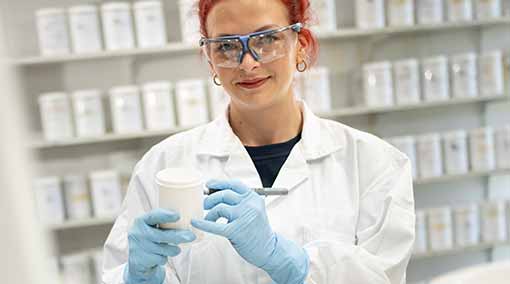

Q&A with April Tetlow

How does the physical form of Pearls — as a solid, volumetrically dosed colorant — influence the measurement precision of color delivery in POS systems?
There are significant dispensing advantages with Pearls. Since Pearls are dispensed in a solid form, the Pearls have a clean release from the dispenser which results in the entire colorant dose being reliably dispensed every time, unlike liquid dispensers, where a lingering drop of colorant may adhere to the dispenser nozzle and not be dispensed. This lingering drop may be an extra drop of colorant in the next dispense. For an off-white color, being a drop too little or too much may significantly alter the color accuracy.
Also, liquid dispensers require daily maintenance for accurate tinting. In particular, nozzle purging, especially for low-VOC colorants, is critical. If these maintenance processes aren’t performed regularly and properly, mistints can occur because of a partially clogged nozzle due to colorant drying at the nozzle tip. In contrast, the Pearls being a solid colorant, there is no colorant drying and no nozzles to be plugged. Basically, the Pearls dispenser is extremely easy to use with virtually no maintenance.
What advancements in spectrophotometers are helping your team push the boundaries of color formulation with Pearls?
Not only for Pearls, but for color matching in general, requests continue to rise to have accurate color matching capability at a POS location. The availability and performance of lower-cost portable spectrophotometer models with good color accuracy in the industry has significantly risen. These instruments are being used as a tool and eliminate the need for the color matcher to handle making formulas or adjustments manually relying on visual judgement. This saves significant work time in completing a color. The Innovatint software is set up to work with this wide range of spectrophotometers: from high-end bench top units and mid-range POS instruments to small portable devices.
3. Can you walk us through how your team approaches a customer’s request to complete an initial evaluation for to using Pearls in their coating/base system?
For an initial evaluation, there may be a range of questions that the customer is interested in, so we would first have a Teams call with the customer to gather information about their application, find out what they are looking for, and request materials that will be needed to conduct the color work. Often, the customer may have already received Pearls samples for evaluation, so their findings or any questions that they may have are also part of the discussion in this meeting.
Typical materials that would be needed are:
-Base material
-Color targets
-TDS and SDS documents
Two important questions customers have for an initial evaluation are:
–Is the Pearls colorant line suited for my company’s coating / application?
The first requirement is that water must be available in the customer’s system or process to hydrate the Pearls. We have seen Pearls succeed in a variety of systems and applications even two component systems. Every customer’s system and application is unique from the viscosity, chemistry, and application method
What is needed is to check out compatibility, color development, and how Pearls incorporate into their system.
The next area for evaluation is the Pearls color space compared to the color targets that the customer wants to achieve. With all this in mind, it is also important to ensure that the costs align with what is needed.
–What is the cost difference between using Pearls and either the current liquid colorants that are currently being used or my current process?
The best way to demonstrate this is to take a selection of colors that the customer already has formulas for using their current colorants and then match them with Pearls. This is usually between 10 – 25 colors. The tint costs can then be provided and compared to their current tint costs.
Since many factors add to the true cost of a color produced, cost advantages with Pearls generally include:
-No colorant wasted when discarding emptied Pearls containers
-Lower maintenance costs for dispensers
-Reduced cost/time to address cleaning
-Shortened manufacturing time, less energy required for applications that replace the use of dry pigment with Pearls
Once the initial evaluation has been completed, Color Science and the Commercial Team will meet with the customer to present the findings and data and then discuss next steps.
How do you collaborate with other teams (R&D, production, application specialists) to maintain or improve Pearls’ color performance from lab to real-world applications?
Any feedback we receive, we will share with the appropriate department. This could be a question about a specific batch (QC department and production), a request or interest shown for a specific pigment chemistry (product management and development), a sample request (sales), request for a capability in Innovatint (Product Management and Innovatint Development Team), or investigation into a specific application (application specialists). In addition to sharing feedback, we are invited to collaborate with various departments to give input and discuss thoughts on future directions.
Looking ahead, are there any upcoming capabilities — whether in expanded color spaces, color formulation capabilities, or material applications — that you’re most excited about for Pearls?
Working in Color Science, we are always enthused when another pigment chemistry becomes available for use. Development is continuously adding more pigment chemistries. The requests that we have been getting show interest in additional pigment chemistries for wood-stains, IRR, construction, and architectural applications. We do welcome pigment chemistry requests from our customers, which help in setting prioritization.
In terms of color formulation capabilities, in addition to the excellent color match capability of the Innovatint software, we are so excited to have the Total Solar Reflectance (TSR) module available for use. This allows the % TSR to be provided for a predicted formula and aids greatly in formula selection. With the foundation of IRR pigment chemistries already in the Pearls colorant line, the TSR module is an excellent tool.
For material applications, it has been so interesting to see the varied applications that Pearls can be used in. As long as water is available in the coating formulation or process, Pearls, with their minimal amount of additives, may be well suited for the application and definitely worth having an initial evaluation conducted.
How does the Color Science team translate a trend-driven color like Vibrantz’s 2026 Color of the Year “Infinity Blue” from concept to a highly accurate, repeatable color using Pearls across different bases and applications?
Having the needed pigment chemistries is key to the success of a trend color. With Pearls’ diverse pigment chemistry selection and broad color space, Infinity Blue is well suited for Pearls. A general Pearls color formula has been established for Infinity Blue, which may be used as a starting point formula.
Also, with the Innovatint software, Color Science has the capability to efficiently provide a specific Pearls color formula for a specific paint base or coating. Additionally with the Pearls rigorous quality control process and tight tolerances, any established color formula within the Pearls broad color space formula, including Infinity Blue, may be dispensed repeatedly with good color accuracy.
How does Vibrantz’s Color Science team support Pearls customers — ensuring accuracy, troubleshooting challenges and helping customers succeed with Pearls in their day-to-day operations?
The Color Science team is happy to assist our Pearls customers throughout the entire implementation process. Often our involvement starts with an initial evaluation of the colorant line for their application. Once the Pearls system has been purchased, we conduct color work to prepare the colorant database. When the database is complete, we train the customers on the laboratory and POS software. Color Science will also help in support of day-to-day operation if a question arises about the Pearls system; this may be related to software operation, dispenser operation or the Pearls colorants themselves.


